Blue Moon
Other climbers
20,00 €
Available

 Enlarge photograph
Other climbers
10,00 €
Available
Price includes VAT
Chinese magnolia vine – Schisandra Chinensis
Height: up to 8 m
Growing conditions in Latvia’s climatic zones: western, central and eastern zone.
Crown: a very vigorous, deciduous climber that can reach as much as 8 m in height. Shoots are green at first, turning yellowish brown as they mature; the bark on the oldest branches is dark brown and furrowed. It twines around supports clockwise.
Flowers: unisexual, 3–5 at the base of the shoot, creamy white, about 2 cm in diameter, fragrant; their scent, like that of the other parts of the plant, is reminiscent of lemon and resin. Buds open and shoots begin to develop in the second half of May; it flowers in early June.
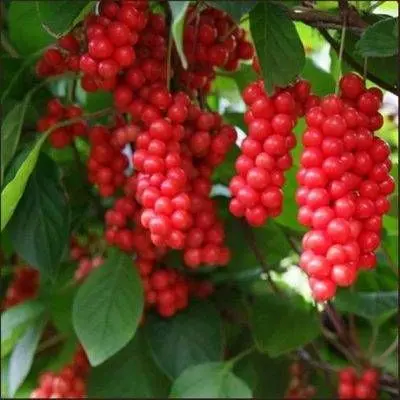
Fruit: a juicy aggregate fruit, or in simple terms, berries resembling a loose 8 cm long currant cluster, orange-red, round, up to 1 cm in diameter. The flesh has a pleasant sour taste; the seeds are up to 3 mm wide, orange-yellow, with a sharp, strong, resinous flavour. Ripens in late August and early September. After planting, it begins to bear fruit in 3–5 years. Up to 5 kg of fruit can be harvested from one plant.
Foliage: 5–10 cm long, elliptic, with a gradually tapering tip; the upper side is green and smooth, the underside lighter and slightly hairy along the veins; in autumn they turn yellow rather early.
Winter hardiness: shoots are only partially damaged by frost in winters especially unfavourable for overwintering, when frost follows a thaw. At the end of winter, branch bark may be scorched by the sun. Frost hardiness -30oC to -40oC
Growing conditions: A very vigorous, deciduous climber that can reach as much as 8 m in height. Shoots are green at first, turning yellowish brown as they mature; the bark on the oldest branches is dark brown and furrowed. It twines around supports clockwise. Sometimes one hears stories that this plant is dioecious and that both a male and a female plant are needed. But this happens when the plant has been raised from seedlings and in the first flowering years only male flowers with 5 stamens are formed, while in later years female flowers also appear in the upper tiers of branching, with rounded carpels slightly elongated at the tip and with stigmas. For planting, choose a sunny place, though it also grows well in partial shade. It requires humus-rich, moist but not waterlogged soil. Plant the plant 0.5–1 cm deeper than it was growing in the container. If planting near building walls, keep at least 30 cm away from them.
Care:Fertilising. In spring, before bud break, sprinkle 30 g of ammonium nitrate around the plant. Well-rotted manure may also be worked in. Later, fertilise with a compound NPK fertiliser. In autumn, after harvest, at the end of September, fertilise with phosphorus and potassium mineral fertilisers. Loosen the soil around the trunk very carefully and shallowly so as not to damage the root collar and roots.
Training: Prune in spring while leafless. Remove thin, weak, broken and unnecessarily crown-thickening shoots. Prune the vegetative shoots to obtain the desired shape of the Citronliāna crown.
Medicinal value.Fruits, shoots, roots and leaves contain tonic and stimulating substances that reduce fatigue in the human body, restore vigour and energy, as well as increase working capacity, improve vision, and help in cases of physical and mental overexertion and depression.
Contains vitamins E and C and microelements necessary for the human body. The berries can be eaten fresh, dried or frozen. They are delicious mixed with honey.
At any time of year, especially in winter, shoots can be cut, poured over with boiling water, left to infuse for half an hour, and the pale yellow shoot infusion used.
A tasty, tonic tea can be made from Citronliāna leaves. In summer, pour a glass of boiling water over 1–2 fresh leaves, and in winter over half a teaspoon of dried leaf; leave to infuse for half an hour, then drink 1–2 glasses a day. It is not recommended in the evening, as it may make it difficult to fall asleep.