Citronliāna
Other climbers
10,00 €
Available

 Enlarge photograph
Other climbers
20,00 €
Available
Price includes VAT
Wisteria macrostachya – Kentucky wisteria
,Blue Moon,
A hardy variety developed in North America
Height: in Latvia it can reach up to 5–6 m in length, 1–2 m per year.
Growing conditions in Latvia’s climatic zones: western, central, more rarely eastern zone
Crown: a deciduous climber whose shoots twine around a support. Shoots with greyish-brown bark.
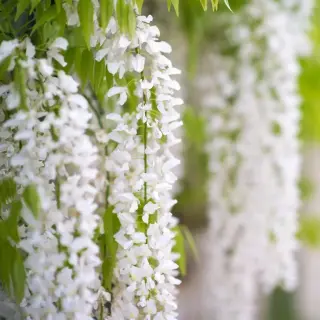
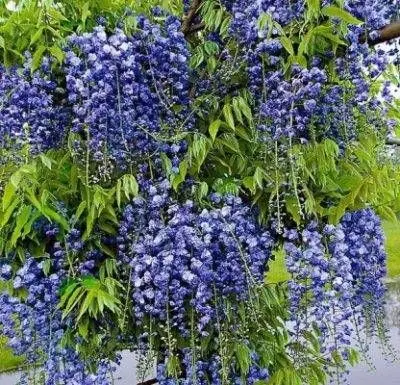
Flowers: blue, pea-like, fragrant, in pendulous clusters 15–30 cm long. Blooms in late June, early July; if pruned, it blooms again in mid-August, but with fewer flowers. Begins flowering in the 2nd–3rd year after planting.
Fruit: if the shoots are not pruned after flowering, pods 10–15 cm long covered with velvety hairs develop. The pod is elongated, knobbly, opening along two seams. Seeds are poisonous!
Foliage: leaves alternate, odd-pinnate compound, with 9–13 leaflets, dark green, yellow in autumn.
Hardiness: frost resistance to -40˚C, a hardy variety developed in North America.
Growing conditions: the best place to plant is a sunny spot on the south or east side of a building, sheltered from wind. Soil fertile, moderately moist. Work compost or other organic fertiliser into the planting site. When planting, it is recommended to plant the plant 5 cm deeper than it grew in the container, and water well. It is better to choose plants at least 3–4 years old. In the first year after planting, it is recommended to pinch off the flower buds so that energy is not spent on flowers but on better root development. For a couple of years after planting, young plants settle into the new location, then growth becomes more vigorous and annual growth is 1–2 m. It is recommended to cover wisteria during the first couple of years after planting by adding a 20–30 cm layer of dry peat over the roots. The branches can be bent down and covered with spruce branches or woven reed mats. Once the wisteria has grown and formed strong main shoots, it no longer needs covering.
Supports
Wisteria can be used to cover pergolas, arches, arbours, verandas, balconies, or walls of buildings. Supports should be made quite sturdy, as they must bear considerable weight. Metal structures are good, but in winter plants may suffer frost damage next to metal; however, the experience of the last five years shows that it also does well on it, attaching itself to the support by twining its shoots clockwise around it.
Care:Fertilising. For fertilising in spring — in April and May — use a compound NPK fertiliser, or work compost or manure into the soil around the plant.
Training and pruning. Every summer in July after flowering, wisteria is pruned, shortening the new shoots to about 15 cm. In spring, prune the shoots growing from the framework branches, leaving 2–3 buds. This will encourage abundant flowering and prevent dense growth. Wisteria forms its flowers on the current year’s shoots.
Usually the soft, unripe shoots freeze back in winter, but the framework branches become firm and thick.