Blue Moon
Other climbers
20,00 €
Available

 Enlarge photograph
Other climbers
7,00 €
Sold out
Price includes VAT
This variety is sold out at the moment. Soon you will be able to leave an e-mail address here to be told when it returns.
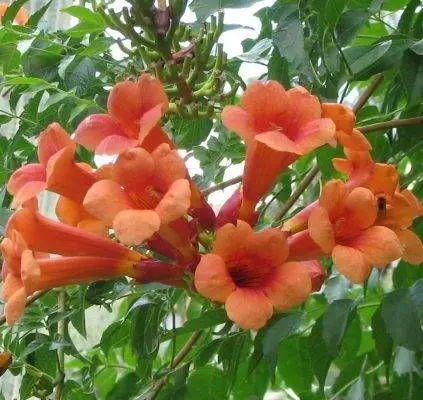
Trumpet vine - Campsis radicans
Campsis radicans stands out in Latvia for its very good winter hardiness and splendid flowering.
Height: vines 6–10 m long
Growing conditions in Latvia’s climatic zones: western, central, more rarely eastern zone (requires winter protection)
Crown: vigorous-growing vines that climb using aerial roots. Young shoots are green, becoming light brown as they mature during the current year; older ones are covered with flaky brown bark. Older shoots at the base of the plant may reach several centimetres in diameter.
Flowers: blooms from mid-July to the end of September with showy, orange-red, trumpet-shaped flowers 5–7 cm long, arranged in panicles or corymbs. Flowers form at the ends of the current year’s shoots.
Fruit: after flowering, fruits form—elongated capsules (pods) containing seeds; these also develop in Latvia.
Foliage: leaves opposite, odd-pinnately compound, may reach as much as 40 cm in length; leaflets toothed with short stalks, up to 10 cm long, green, turning yellow in autumn.
Winter hardiness: young, unripe shoots are damaged by frost in winter. In more severe winters only the upper part of the plant may freeze back, when temperatures drop below -25oC to -30oC, but it regrows quickly, reaching at least 4 m in a single summer. In spring, trumpet vine wakes late; buds appear only in the second half of May, and many think it has died over winter because the shoots look dry and budless. Overwintering can be checked by gradually cutting back the shoots and looking for green tissue in the centre; if it is brown, continue cutting back until green tissue is reached. Intensive growth begins at the end of May, and by June strong shoots have already formed, with flower buds beginning to develop at their tips.
Growing conditions: to avoid damaging house walls, it is not advisable to plant it close to buildings. Leave at least 50 cm from the wall, as it will readily attach itself with aerial roots to any building material. Provide a sturdy support. For abundant flowering, choose a sunny place, or at least one that receives sun for half the day; this may be on the east, south or west side. If the site is protected from prevailing winds, trumpet vine can certainly also be planted by pergolas, arches and gazebos. I would not recommend planting it on a fence with metal mesh and exposed to prevailing winds. Plant in humus-rich, moderately moist soil, incorporating compost or other organic fertiliser into the planting site. If trumpet vine likes the place assigned to it, it will flower abundantly, grow vigorously and send up root suckers, which must be pulled out regularly, as it is in fact considered an invasive plant species. For planting in a permanent place, it is better to choose plants at least 3–4 years old. Plant 0.5–1 cm deeper than it was growing in the container.
Care: Fertilising. In spring, before bud break, apply 30 g of ammonium nitrate around the plant. Well-rotted manure may also be worked in. Later, feed with a balanced NPK fertiliser.
Training and pruning. Pruning is important for trumpet vine. During the first couple of years after planting, shape it by pinching back at least one third of the shoot so that it produces side shoots, which will become the framework branches; direct these sideways so the plant develops in width, and remove the weaker shoots. Thereafter, in spring (April), or also in autumn after leaf fall, cut back the shoots growing from the framework branches, leaving 2–3 buds. This will encourage abundant flowering and prevent it from becoming an overgrown garden “wild thing”.
Usually the soft, unripe shoots freeze in winter, but the framework branches become firm and thick.
Winter protection. During the first couple of years, the shoots can be bent down for winter. When frost sets in, heap dry peat or other dry material over the root area and cover the shoots with spruce branches or woven reed mats. Once the trumpet vine is older, it can be left uncovered for winter on its support.
Supports. For a newly planted young trumpet vine, at first it will be enough to place a 1.5 m long bamboo or plastic stake beside it and tie the plant to it, but a proper support should be planned. A wooden frame is attractive, and trumpet vine also clings better to it with its aerial roots, but over time it will rot, which suggests considering a metal frame that would last longer. From experience, I can say that trumpet vine will prefer to attach itself to the wall of a building rather than to the support intended for it; in this case, clips used for securing tomatoes can be helpful, as they can hold it very well against the support.