Blue Moon
Other climbers
20,00 €
Available

 Enlarge photograph
Other climbers
8,00 €
Available
Price includes VAT
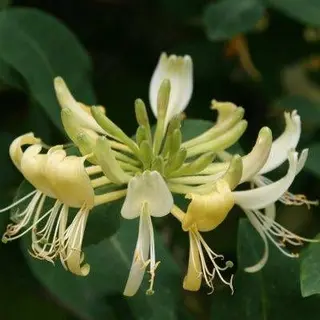
Hecroft honeysuckle -Lonicera heckrottii
'Goldflame"
Height: a climber up to 3 m long, with annual growth of 1 m
Growing conditions in Latvia’s climatic zones: western, central, eastern zone
Crown: a vigorous climber, the shoots twine around the support in a spiral. Shoots are grey-brown in colour.
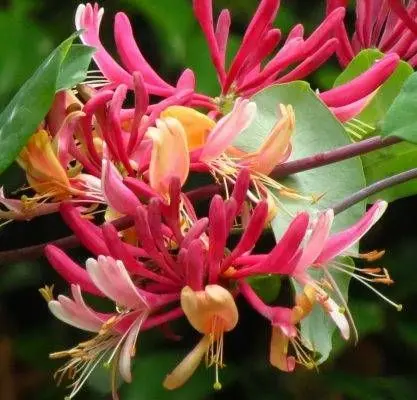
Flowers: carmine red, pink on the outside and orange inside after opening, pleasantly fragrant, 4 cm long, two-lipped, arranged at the ends of the shoots, flowers abundantly in June–July, less intensely until September. Flowers on the previous year’s shoots. The fragrance is more intense in the evenings.
Fruits: after flowering, fruits form – spherical, red-orange berries, 0.5 cm in diameter, ripen from August to October, inedible.
Foliage: leaves dark green above, bluish green beneath, elliptical, 3–6 cm long.
Winter hardiness: in severe winters, young unripe shoots may suffer frost damage. A very winter-hardy, frost-resistant variety throughout Latvia.
Growing conditions: suitable for both a sunny and a partially shaded location. The space intended for climbing honeysuckle need not be very large; about a metre of free space is enough. As regards soil requirements, prepare a humus-rich, loose, moderately moist soil; it is better to improve it with compost or well-rotted manure or its substitutes. They do not like clayey and heavy soils. When choosing plants, two-year-old and three-year-old own-root plants are recommended. Plant 0.5–1 cm deeper than it was grown in the container.
These plants have lush foliage and are fairly fast-growing; they need moisture to build up green mass. Water thoroughly when planting, then mulch to preserve moisture. Annual growth up to a metre.
Diseases, pests: the biggest drawback is the development of powdery mildew in the second half of summer. For prevention, in autumn after leaf fall, spray with a 2% Bordeaux mixture. This can also be done in spring before leaf break. In summer, dust with sulphur if the air temperature is not below +20 degrees.
Climbing honeysuckles are also visited by aphids. They are controlled with insecticides as soon as the first pests appear.
Care: Fertilising. For fertilising in spring, nitrogen or well-rotted manure may be used. After flowering, climbing honeysuckles can be treated with calcium-containing mineral fertilisers, which will strengthen the root system.
Training. Prune once a year after flowering. This will affect the plant’s flowering; new shoots and new flower clusters will form. With regular pruning, the plants will not develop a dry lower part.
Winter protection.For the first couple of years, the shoots can be bent down for winter. Once frost sets in, mound dry peat or other dry material over the root area and cover the shoots with spruce branches or reed matting. Once the climbing honeysuckle is more mature, it may be left uncovered for winter.
Supports. Supports should be 3–5 cm in diameter and, depending on how they are made, the climber can be directed to grow in different ways. It can be grown against building walls, fences and pergolas. Supports may be made of various materials, but less winter-hardy ones should preferably not be planted by metal.