Blue Moon
Other climbers
20,00 €
Available

 Enlarge photograph
Other climbers
20,00 €
Sold out
Price includes VAT
This variety is sold out at the moment. Soon you will be able to leave an e-mail address here to be told when it returns.
Hydrangea schizophragma -
Schizopragma hydrangeoides
''Burst of Light"
Bred in Japan, on the market since 2016. It received gold medals at the "Flowers Expo" exhibition in 2016 and at the Salon du Vegetal exhibition in 2018 in Nantes, France.
Height: in Latvia it can reach 4–6 m in height, annual growth 0.5 m
Growing conditions in Latvia’s climate zones: western, central, more rarely eastern zone
Crown: a deciduous climber that climbs using aerial roots. Shoots copper-brown with peeling bark.
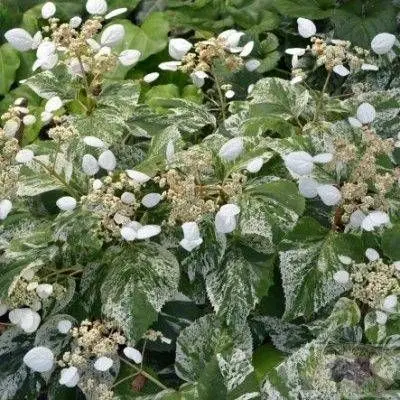
Flowers: the flowers are creamy white, arranged in flat corymbs, and bloom in the second half of June and in July. The inflorescences are fragrant, with a honey scent, 15–20 cm in diameter. The flowers are sterile. At the end of flowering, the cluster of sterile flowers takes on a greenish tint. In winter it retains dry, brown inflorescences, but they fall off by spring.
Fruits: inconspicuous dry capsules with seeds, of no ornamental value, persisting through winter.
Foliage: leaves very decorative, 12–18 cm long, broadly ovate, coarsely toothed, with irregular white and green blotches.
Winter hardiness: frost resistance to -25oC, but Latvia’s fluctuating winter air temperatures may cause damage, as the young buds are already ready to open when the leaves fall in autumn. The whole plant may be damaged by frosts in May.
Growing conditions: feels best in partially shaded places. As for soil, choose humus-rich, loose, moderately moist soil, pH 5.0; well-rotted leaves may be used, and mulching with pine bark mulch is recommended to maintain moisture. It is recommended to plant the plant 0.5–1 cm deeper than it grew in the container. Watering is recommended in dry weather.
Important to know!No matter how large a hydrangea schizophragma plant you buy, it needs 2–3 years to establish well. During this time it will stay green, but will not make growth. Its roots develop slowly, and while it is establishing, it must be left undisturbed. People think there is something wrong with the plant and begin watering, fertilising, or replanting it additionally, but all that is needed is patience.
Supportsrecommended for planting are those made of natural materials. Around an old living tree, a pine trunk, a post, against stone, concrete, or a brick wall. Planting by a house wall should be seriously considered, however, because the plant will cling to it with remarkable force using its suckers. It is recommended to plant the plant 0.5-1 cm deeper than it grew in the container. Watering is recommended in dry weather.
Care:Fertilising. Fertiliser intended for hydrangeas may be used for supplementary feeding.
Training. Hydrangea schizophragma does not need its shoots pruned or its crown shaped; this is done only if a shoot is in the way. The most favourable time for pruning is spring. It does not need winter protection; it is recommended not to throw snow on it, as the brittle shoots can be damaged by heavy snow cover. Of course, the climber has dormant buds that recover quickly.