Citronliāna
Other climbers
10,00 €
Available

 Enlarge photograph
Berry plants
7,00 €
Sold out
Price includes VAT
This variety is sold out at the moment. Soon you will be able to leave an e-mail address here to be told when it returns.
Haskap – Lonicera kamtschatica ,Zojka
Height: can reach up to 1.7 m, 1.5 m wide
Growing conditions in Latvia’s climate zones: can be planted throughout the territory of Latvia.
Crown: vigorous, oval-shaped shrub; young shoots are green, mature ones brown.
Flowers: blooms in April with pale yellow, inconspicuous, soft, funnel-shaped flowers. During the blooming period, the flowers can withstand temperatures down to -8°C for nine hours. Self-sterile; for pollination, another variety of this species is needed, such as , Leningradskij Velikan, ,Docz Velikana, and others.
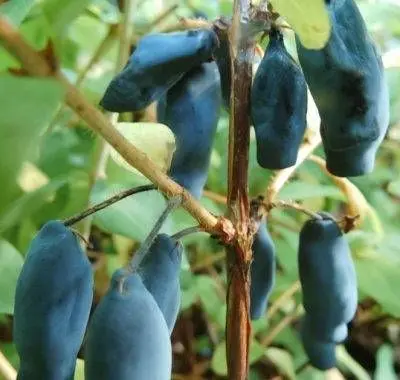
Fruit: oval-elongated, dark blue berries with an uneven surface and a fine waxy coating, very tasty, sweet-sour, dessert-type berries. Ripen 30–40 days after flowering, at the beginning of June. The fruit is suitable both for processing and for fresh consumption.
The most convenient harvesting method: spread cloth or other material under the bush and, for example, shake the bush with a rake handle so that the berries fall onto the cloth. They can also be picked by hand.
Foliage: leaves rounded-elongated, 6–10 cm long, bluish green.
Winter hardiness: very hardy throughout the territory of Latvia. Frost resistance -34oC to -40oC
Growing conditions: choose a sunny location for planting haskap. It requires humus-rich, moist but not wet soil, with a soil reaction of 5.5–7 pH. Prepare a planting hole 50 x50 cm deep and wide, filling it with compost or other organic fertiliser. Plant the plant as deep as it grew in the container and water thoroughly. As haskap has a shallow root system, it is recommended to water it during the growing season, as it is sensitive to drying out. Planting distance from one another 1 m. Mulching is recommended to retain moisture.
Important to know! If the soil is too dry for a long time, bitterness may appear in the fruit.
Protect from hares! They gnaw the young shoots, but haskap bears fruit on this year’s one-year-old shoots!
Care: Fertilising. In spring, on moist soil, apply 30 g of ammonium nitrate around the plant. Well-rotted manure or compost may be incorporated. Later in the growing season, fertilise with a complex NPK fertiliser. Loosen the soil around the bush very carefully and shallowly, so as not to injure the root collar and roots.
Pruning: After planting in a permanent place, haskap is usually not pruned for at least 5–6 years. Sanitary pruning is needed no earlier than after 6–7 years. The best time for pruning is after harvest. On fruiting haskap bushes, the shoot tips must not be cut, because this is where the flower buds that will form the crop are most highly concentrated. The framework branches must also not be cut out at the base, because crown renewal takes place thanks to dormant buds at the base of the framework branches.
Medicinal value.The fruit is rich in vitamins, macro- and microelements (magnesium, iron, copper, iodine), contains antioxidants, sugars, tannins, fibre, pectins, and organic acids. These activate metabolism in the human body. They have antioxidant, anti-inflammatory and antiseptic properties.
The berries can be eaten fresh, dried or frozen. They can be used to make jams, compotes, juices and jellies.